How to Gamify Your Life
You have played games for hours without anyone asking, then struggled to do ten minutes of something that is actually good for you. That gap is the whole idea behind gamifying your life: borrow the parts that keep you playing, and point them at the things you keep putting off.
 CharacterSheet is an iPhone and Apple Watch appPoint your iPhone camera at the code to install it.
or text me the link
Yes, you can, and here is the short version
Yes. Pick the few things you want more of, pay yourself points for the minutes you put into them, add the points up into levels, and give yourself a small goal with a deadline each week. Look at the score every day. That is the core loop, and it runs on paper.
Apple already does a slice of this for movement. With an Apple Watch, the Activity rings close when you hit your Move, Exercise and Stand goals, and you earn awards for personal records, streaks and milestones. For a plain checklist, a repeating list in Reminders works. What none of the built-in apps do is cover the rest of your life in one score: reading, meditation, chores and training on the same scale.
Expect a real but modest effect. Across randomised trials, games built around exercise moved people a measurable amount, and some of it stayed after the game ended (see what the research says). It works best as feedback on what you already chose to do, not as payment for things you dislike (see when points backfire).
Does gamifying your life actually work?
The clearest evidence is for physical activity, because steps are easy to measure. A 2022 meta-analysis in the Journal of Medical Internet Research pooled 16 randomised controlled trials with 2,407 participants. Gamified interventions raised physical activity with a small to medium effect (Hedges g = 0.42). At follow-up, an average of 14 weeks after the interventions ended, the effect was smaller (g = 0.15) but still there.
A separate trial shows what the numbers look like for real people. Researchers at the University of Pennsylvania gave 200 adults from 94 families in the Framingham Heart Study a step goal. Half also played a game with their family, earning points and moving through levels for meeting the goal. Over 12 weeks, the game group added 1,661 daily steps over their starting average, against 636 in the control group. In the 12 weeks after the game, the game group slipped to 1,385 extra steps, still ahead of the control group's 798.
Two lessons come out of that:
- The game does something. It is not magic, but a thousand extra steps a day is real walking.
- The effect fades when the game stops. So build a game you can keep playing for months, not a 30-day challenge.
There is a third, quieter reason it works: keeping score. A 2016 meta-analysis of 138 studies with 19,951 participants found that people who monitored their progress reached their goals more often, and the effect was larger when progress was physically recorded and when it was reported or made public. A score is a record you look at.
When points backfire
Rewards can hurt motivation, and it is worth knowing how. A 1999 meta-analysis by Deci, Koestner and Ryan looked at 128 experiments. Tangible rewards, and rewards people expected in advance, lowered intrinsic motivation: people did less of the activity on their own once the reward was gone. Positive feedback did the opposite and raised both free-choice behaviour and interest.
For a life game, that suggests three rules:
- Make points feedback, not a wage. A number that shows how much you trained is information. "I get a takeaway if I run" is a deal, and deals can turn the thing you liked into a chore.
- Gamify what you already want. Reading more, moving more, a calmer evening. Do not use points to force yourself through something you have no reason to do.
- Watch for gaming the game. If you catch yourself picking the activity that pays the most instead of the one you need, change the rules so the easy option stops paying.
Step 1: Decide what counts
A game needs a board. Pick four to six areas of your life and give each a name, like stats in a role-playing game. Cover body and mind, so the game cannot be won by doing one thing:
- Strength, Endurance and Agility for the body
- Wisdom for reading and learning, Spirit for quiet practices like meditation or journaling
- Willpower for the small daily things: admin, chores, not snacking after dinner
Then give every activity one home. A run is Endurance, a chapter of a book is Wisdom. The guide to levelling up in real life like an RPG character goes deeper on picking stats and letting the weakest one lead.
Step 2: Pay points for time
Pay for minutes, not results. You cannot decide how fast you get stronger this month. You can decide whether you trained for 30 minutes today. One point a minute is enough to start.
Time it, do not estimate it. The Clock app's stopwatch is fine. "About an hour" is how 40 minutes becomes 60, and a game you cheat at stops meaning anything.
Step 3: Turn points into levels that get harder
Levels give the points a shape. The first few should come fast, within a week or two, so the game gets going. Later ones should take real work. A simple rule on paper: each level costs a bit more than the last.
Also stop paying for what has become easy. A walk is real training on day one. A year in, it should not level you up any more. That pushes you towards harder work at the pace you can handle.
Step 4: Add quests with a deadline
Points reward effort. Quests give it a direction. A good quest is specific, has a finish line and a time limit: "Three runs this week", "Read 100 pages by Sunday", "Meditate five days in a row".
Keep two or three open at once. More than that and none of them feels urgent. When one is done, pay a bonus and pick the next.
Step 5: Add a streak with a low bar
A streak is the cheapest motivation in any game: all you have to do is not break it. Make the bar small enough to clear on your worst day, like five minutes of anything. And decide now what a miss costs. A counter that drops to zero after 40 days makes day 41 feel pointless. The guide to keeping a workout streak going has the details.
Step 6: Give yourself something to lose
A score that only goes up turns into a trophy. If a stat slowly loses points when you neglect it, the game shows you what you have been skipping. Keep the loss small: a few points, never a whole level. The point is a nudge, not a punishment that makes you quit.
Step 7: Look at the score every day
Pick one fixed moment, like after dinner, and look at the board. The monitoring research found that interventions worked partly by making people check their progress more often. If your game lives in a notebook in a drawer, it is not doing that job. On iPhone, a Home Screen widget keeps it in sight; the guide to setting up a habit tracker on iPhone shows the Reminders widget step by step.
Gamifying life with ADHD
"Gamify life ADHD" turns up in search suggestions, so it deserves a straight answer: the research does not settle it yet. A 2025 systematic review of serious video games for ADHD covered 37 studies, all in children and teenagers, and found too few high-quality studies to say the games change real-world behaviour. It says nothing either way about adults scoring their own routines.
That does not mean it cannot help you. Some design choices may suit you better than others, and they cost nothing to try: short sessions with a clear end, a score that moves the moment you finish, a small list chosen for you so you do not stall on deciding, and a miss that costs a little instead of everything. Treat it as a tool you test on yourself, and keep any treatment you have with your doctor.
Doing it in an app instead of a notebook
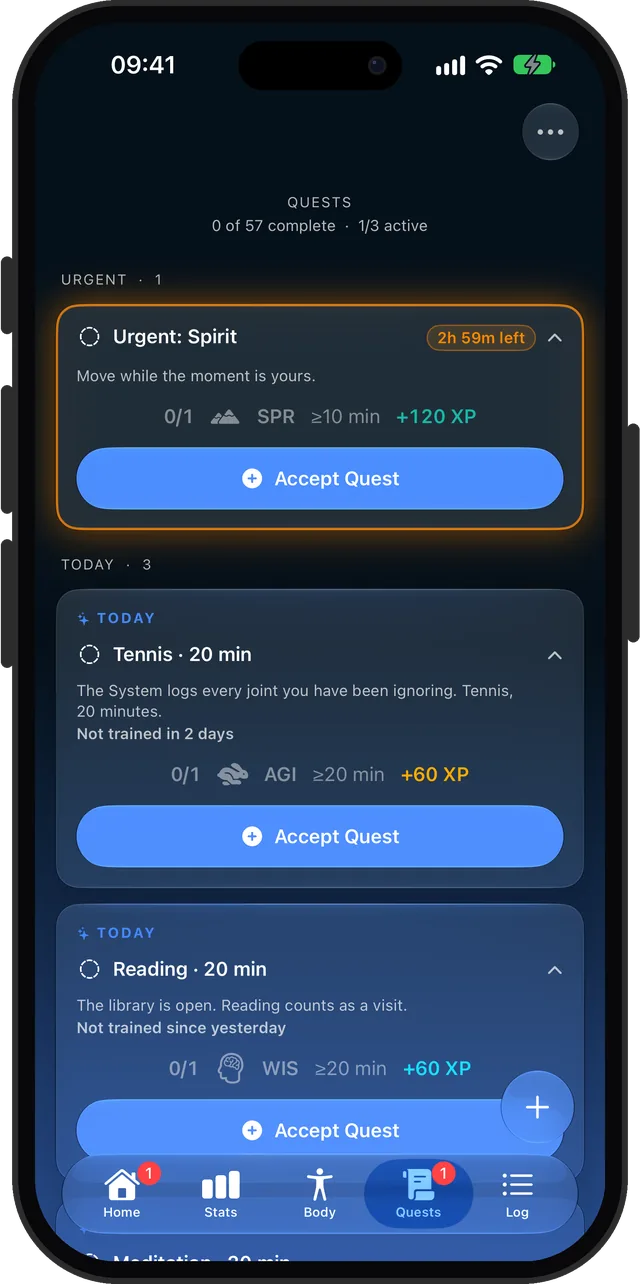
Paper breaks in two places: you forget to write things down, and you do the maths generously. CharacterSheet is a fitness RPG for iPhone and Apple Watch that runs the rules above for you:
- Six stats. Strength, Endurance, Agility, Wisdom, Spirit and Willpower, each levelling from 1 to 60. Your character's level is your lowest stat, so the neglected one shows.
- XP by the minute. Start the timer on an activity and XP comes for each minute. An activity that is hard for your level pays more, and one you have outgrown pays nothing.
- Quests. 57 written quests, some open from day one and some unlocked by finishing the one before. You can run three at a time, and a daily rotation and urgent quests come on top.
- A streak with a low bar. Five minutes of any training lights the day for Momentum, which adds 1% bonus XP per day in a row, up to 50%. A missed day takes two days off the count instead of resetting it.
- Dailies for the small stuff. Up to five daily habits you name yourself. Ticking them trains Willpower.
- Something to lose. Training buys a stat days of cover. A night without cover takes XP from the bar, never a level.
If your game is mostly about exercise, how to gamify your workouts narrows these rules down to training.
Which part fixes which problem
| Your problem | Game part | See |
|---|---|---|
| Nothing feels like progress | Points and levels | Step 3 |
| You train, but without direction | Quests with a deadline | Step 4 |
| You start strong and fade | A low-bar streak | Step 5 |
| One area of life gets ignored | Stats that can slip | Step 6 |
| The reward replaced the reason | Points as feedback | Backfire |
Frequently asked questions
Can you gamify your life?
Yes. Give the things you want more of points for the minutes you spend on them, add the points into levels, set small quests with deadlines and look at the score daily. Trials on gamified exercise found a real, modest effect, smaller once the game ended, so build a game you can keep playing.
How do I start gamifying my life?
Pick four to six areas to track, decide which activities count for each, and pay one point a minute for timed sessions. Add levels that get harder, two or three weekly quests and a streak with a five-minute minimum. A notebook is enough to start.
What is the best app to gamify your life?
It depends on what you want to change. For movement alone, Apple Watch's Activity rings are built in and free. If you want reading, meditation, chores and training on one score, CharacterSheet turns timed sessions into XP across six stats, with quests and a streak, as a subscription with a free trial.
How do you gamify life with ADHD?
Research has not settled it: a 2025 review of 37 studies of games for ADHD, all in children and teenagers, found too few high-quality studies to show real-world change. Things worth testing on yourself are short sessions with a clear end, instant feedback, a short list chosen for you and a miss that costs only a little. Keep any treatment with your doctor.
Can rewards make you less motivated?
They can. A meta-analysis of 128 experiments found that tangible and expected rewards lowered intrinsic motivation, while positive feedback raised it. Use points as a record of what you did, not as payment for things you dislike.
How do I gamify fitness on iPhone?
With an Apple Watch, the Activity rings close for your Move, Exercise and Stand goals, and you earn awards for records and streaks. For points, levels and quests across more than steps, a fitness RPG like CharacterSheet times each session and pays XP by the minute.
Sources
- Mazeas et al. (2022), Evaluating the Effectiveness of Gamification on Physical Activity: Systematic Review and Meta-analysis of Randomized Controlled Trials, Journal of Medical Internet Research
- EurekAlert (JAMA Internal Medicine, 2017): Did game design elements increase physical activity among adults? (Patel et al., Framingham families)
- Harkin et al. (2016), Does monitoring goal progress promote goal attainment? A meta-analysis, Psychological Bulletin
- Deci, Koestner and Ryan (1999), A meta-analytic review of experiments examining the effects of extrinsic rewards on intrinsic motivation, Psychological Bulletin
- Schultz et al. (2025), A systematic review and content analysis of serious video games for children with ADHD, Frontiers in Psychiatry
- Apple Support: Track daily activity with Apple Watch
- Apple: iOS 27